Exported to Japan · Singapore|Fully in-house: ferrite powder → coating resin → finished carrier|500 t/year|approx. 5,000 m² plant|Fujian High-Tech Enterprise

Technology - Three Processes, One Roof

Most carriers are assembled. Ours are made from the powder up. Ferrite powder, coating resin synthesis and finished-carrier production all happen in our own plant in Nan'an - which is why we can answer for every gram of it.

Home › Technology

Stage One - Ferrite powder

Everything downstream is decided here. The ferrite powder determines the magnetic response of the finished carrier, and its particle size distribution sets the ceiling for how uniform the finished particles can be.

Why it matters to you: if a supplier buys powder outside, the first variable in your carrier belongs to somebody else's production schedule. Ours belongs to us.
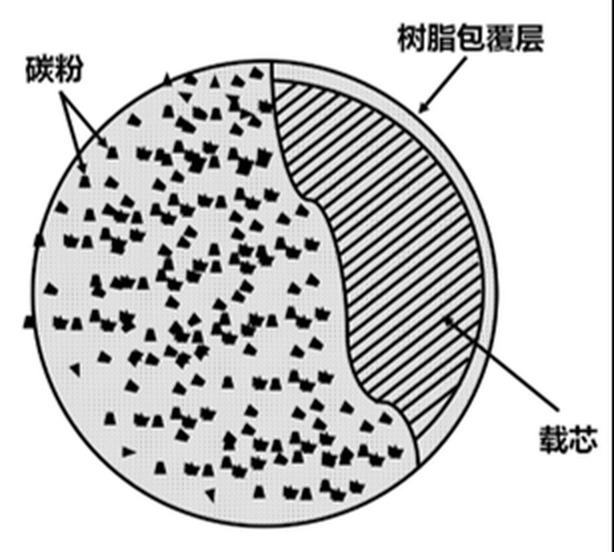
Core-shell structure

Core-shell structure

Stage Two - Coating resin synthesis

The resin is the functional part of a carrier. It controls how much charge the toner picks up, how fast it gets there, and how long the coating survives the developer unit.

We synthesise our own coating resin rather than buying a general-purpose polymer. That is the step that took the longest to get right, and it is the step most carriers skip.

Why it matters to you: two carriers can have identical D50 and identical magnetics and behave completely differently on the drum. The difference is the resin.

Stage Three - Coating and finished carrier

Coating is where the core and the shell become one particle. Coverage, adhesion and coating thickness determine whether the shell stays on the core through thousands of developing cycles - or comes off and lets the bare ferrite show.

Why it matters to you: carrier that loses its coating does not fail loudly. It fades. Density drops, background fog creeps in, toner starts scattering, and the drum takes the blame. A coating that stays put is the cheapest insurance in a developer system.

The core-shell structure, in one paragraph

A carrier particle is a ferrite core inside a polymer resin shell. The core gives the particle magnetic mobility so it can form a magnetic brush and carry toner to the photoreceptor. The shell sets the triboelectric relationship with the toner - how much charge, how stable over time, and how resistant to humidity and wear. Spherical shape and a narrow particle size distribution keep the developer flowing and the density even. That is the whole product, and every one of those four things is made in our plant.

What we measure before a lot leaves

Testing capability covers the parameters that decide print behaviour. We hold a retained sample from every production lot so that any later question can be answered against a physical reference, not a memory.

Specific test methods and specification limits: 【TBD - pending in-house test data】

Every shipment can be accompanied by a Certificate of Analysis against the agreed specification. Request the current TDS at /downloads.

Where the technology is heading

We track four developments in carrier technology, and all four feed our R&D agenda with SCUT:

  1. Low-temperature fixing compatible coatings - reducing fusing energy demand.
  2. Finer particle size with narrower distribution - improving transfer efficiency.
  3. Surface chemistry control - holding charge stability and flow across humidity and temperature swings.
  4. Joint carrier-toner development - carrier makers and toner makers designing together, which is steadily becoming standard practice rather than an exception.

If you are a toner manufacturer working on point 4, that is the conversation we most want to have.

Still comparing suppliers? Send us one machine model and one toner reference

We reply within 24 hours — with a recommendation, not a brochure. Factory visits welcome in Nan'an.

Contact us / Request TDS Download TDS & selection guide
↑